You Already Know What to Do.
You Just Can't Always Say It in English.
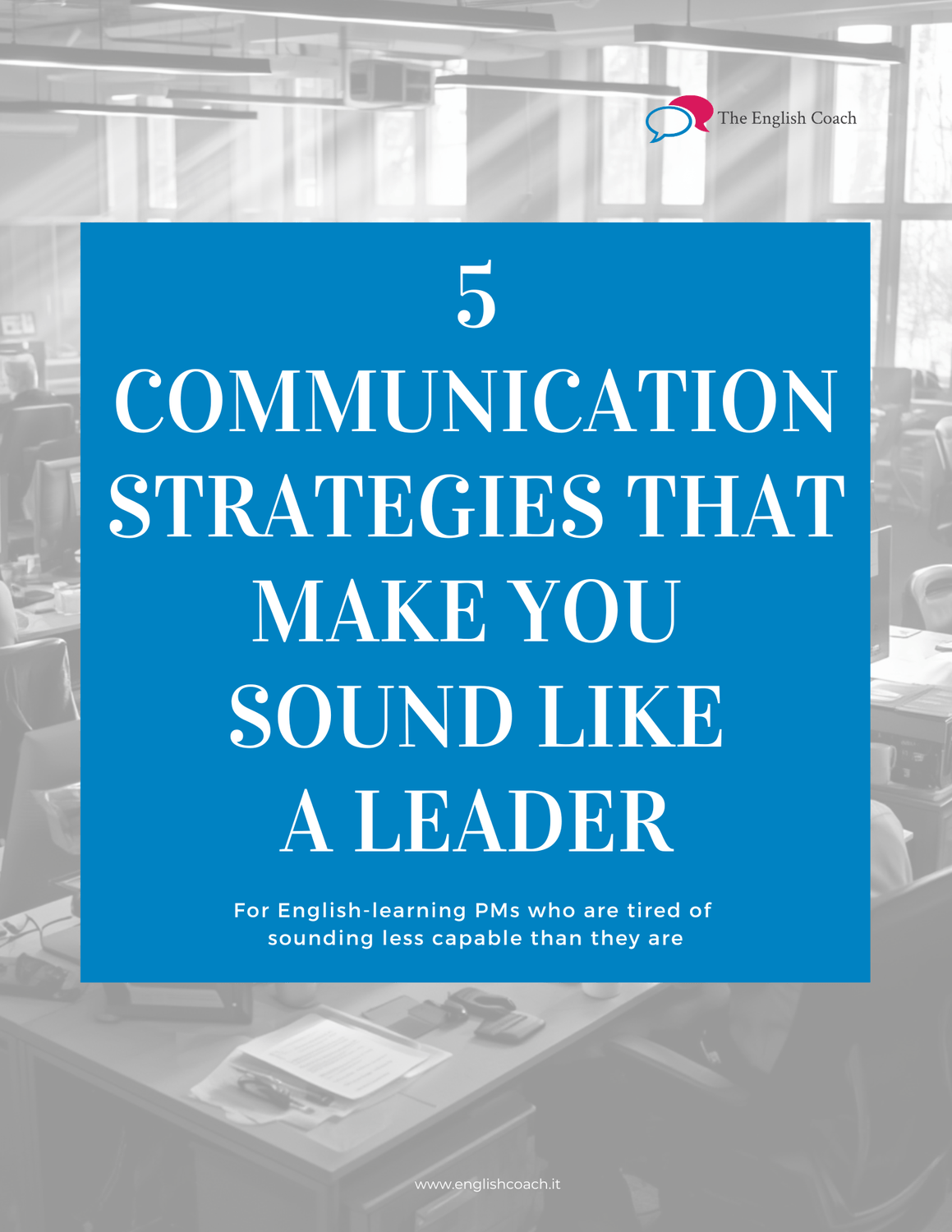
A free guide for non-native English-speaking Project Managers who are tired of sounding less capable than they actually are.
Inside this free guide, you'll find 5 communication strategies used by PMs who were exactly where you are and now run meetings, write stakeholder emails, and handle pressure situations without second-guessing every sentence.
We respect your privacy. Unsubscribe at any time.

You've been in meetings where you had the answer but someone else said it first.
Not because you didn't know, but because by the time you'd translated the thought, structured the sentence, and made sure it sounded right ...
the moment had passed.
You've simplified an idea mid-sentence because you weren't sure the words would come out right.
You've written an email three times before sending it.
You've left a conversation wondering: Did I come across the way I meant to?
And the frustrating part? Your expertise isn't the issue.
You understand the project deeply. You manage complexity that most native speakers couldn't handle. Yet, in critical moments (stakeholder meetings, escalations, cross-cultural negotiations) something gets lost between what you know and what you say.
That gap is costing you visibility, influence, career momentum, and it has nothing to do with intelligence.
Created by Someone Who's Been in Your Shoes
I didn't create this guide as a language teacher.
I created it as someone who's sat in the same room.
I'm Maria. I've spent over 30 years conducting my entire professional life in Italian — my second language. Every negotiation, every client relationship, every high-stakes conversation, in a language not my own. I know exactly what it costs to perform under pressure in your second language, and I know what it feels like when the gap finally closes.
I've seen talented PMs get overlooked for leadership roles, not because of their skills, but because their communication style didn't match the expectations of the environment. I've also seen PMs transform their presence almost overnight, once they had the right frameworks.
These strategies aren't from a linguistics textbook. They come from what I've watched work in real meetings, real escalations, and real career moments for dozens of PMs who now communicate with confidence across cultures.
What's inside:
✓ Strategy #1: Active Listening That Actually Works
Most stakeholders don't say exactly what they mean. This strategy teaches you how to read between the lines even when your brain is half-processing the language. You'll stop missing critical signals and start leading conversations, not just surviving them.
✓ Strategy #2: Asking Questions That Make You Sound Senior
There's a specific way to ask for clarity that makes you look sharp, not lost. This framework gives you the exact question patterns that PMs use to steer conversations without ever seeming uncertain.
✓ Strategy #3: Moving Conversations Forward
Stuck moments in meetings are painful in any language. In a second language, they're terrifying. This strategy gives you the openers and bridges that keep things moving, naturally.
✓ Strategy #4: Speaking Under Pressure
When stakes are high, fluency drops. This strategy is specifically designed for high-pressure moments (escalations, presentations, conflict) where you need to sound calm and credible even when you're not feeling it yet.
✓ Strategy #5: Writing Emails People Actually Act On
The right email structure removes the need to write and rewrite. You'll learn the exact format that gets read, understood, and responded to ... in any cultural context.

According to research by LiquidPlanner,
poor communication is the #1 reason projects fail; accounting for 57% of project failures.
FAQ SECTION
Q: Is this for someone at my level?
A: If you're already working as a PM in English, even if it's not always smooth, this guide is for you. It's not beginner material. These are professional communication strategies for people who know their job deeply but want their English to match.
Q: How long will it take to read?
A: About 20–30 minutes. It's designed to be practical, not padded. Most people finish it in one sitting and have something they can use immediately.
Q: Will I get emails after this?
A: Yes, occasionally, but only content that's directly relevant to professional English communication for PMs. No fluff, no hard selling. And you can unsubscribe anytime with one click..
Q: Why is this free?
A: Because the strategies in this guide represent the foundation of everything I teach. If they work for you, and they have for dozens of PMs, you'll know whether working more closely together makes sense. There's no pitch inside the guide.
If any of this resonated, if you've ever walked away from a meeting wondering whether you really came across the way you intended, this guide is for you.
It won't fix everything in one read, but it will give you frameworks you can use starting today, in your next stakeholder update, your next cross-cultural call, your next email that actually needs to land.